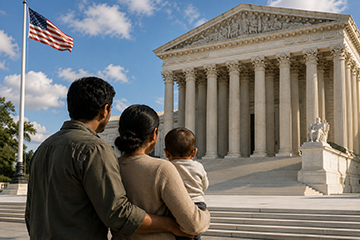
Supreme Court Confirms Birthright Citizenship for Children Born to Parents on Temporary Visas and Other Noncitizens


By: Mishita Jethi, Jioselin Juarez Contreras, Gladys Gervacio, and Deepika Singh | July 1, 2026

On June 30, 2026, the U.S. Supreme Court issued its decision in Trump v. Barbara1, holding that the Fourteenth Amendment guarantees U.S. citizenship to all children born in the United States, regardless of whether their parents are lawfully present or unlawfully present and regardless of whether they are on temporary visas. The Court invalidated President Trump's Executive Order2 dated January 20, 2025, seeking to limit birthright citizenship for these children and reaffirmed the longstanding constitutional interpretation established in United States v. Wong Kim Ark.

What the Supreme Court Held

  • Children born in the United States to parents who are:
    • Unlawfully present; or
    • Lawfully present on temporary visas or other temporary immigration statuses,

are U.S. citizens at birth as per the Fourteenth Amendment.

  • The Court held that the Executive Order restricting birthright citizenship violates both:
    • The Fourteenth Amendment's Citizenship Clause; and
    • The Immigration and Nationality Act.

How the Court Reached This Result

The majority consisting of Justices Roberts, Sotomayor, Kagan, Barrett, and Jackson relied on:

  • The historical common-law doctrine of jus soli (citizenship based on birthplace).
  • The drafting history of the Fourteenth Amendment.
  • The Supreme Court's longstanding precedent in United States v. Wong Kim Ark (1898).
  • The conclusion that the phrase “subject to the jurisdiction” refers to being subject to U.S. sovereign authority while being physically present in the United States—not to a parent's immigration status, domicile, or lawful permanent residence. 

The minority dissent, consisting of Justices Thomas, Gorsuch, Kavanaugh, and Alito, stated that:

  • The Citizenship Clause applies only to persons born and domiciled in the United States, and temporary visitors and undocumented immigrants do not owe the complete political allegiance necessary for constitutional birthright citizenship.
  • The Executive Order conflicted with the current federal citizenship statute but concluded that Congress could constitutionally enact legislation limiting birthright citizenship in the future.

What This Means for Employers, Foreign Nationals, and Families

For employers sponsoring foreign nationals and individuals residing in the United States on temporary visas (including H-1B, L-1, F-1, J-1, O-1, TN, E-2, B-1/B-2, and similar classifications), the decision preserves the longstanding rule that children born in the United States are U.S. citizens at birth.

It is important to note that:

  • A U.S.-born child does not immediately change the parents' immigration status.
  • Citizenship of the child does not provide an immediate pathway to lawful permanent residence or work authorization for the parents.
  • The decision preserves existing constitutional protections for birthright citizenship but leaves open the possibility that Congress may amend the governing statute in a manner that could be upheld by a future Supreme Court decision or that the Constitution itself is amended.

For any questions or assistance, please contact your trusted Chugh, LLP immigration professional.

Source:

1https://www.supremecourt.gov/opinions/25pdf/25-365_4hdj.pdf
2https://www.federalregister.gov/documents/2025/01/29/2025-02007/protecting-the-meaning-and-value-of-american-citizenship

Latest Posts

Categories

  • Top Corporate Lawyers | Business Attorney Services | Chugh Llp
  • Top Tax Attorney & Tax Lawyer Services | Chugh Llp
  • Best Immigration Lawyer & Immigration Attorney : Chugh Llp
  • Find Litigation Lawyer & Business Litigation Services | Chugh Llp
  • Best Family Lawyer & Family Law Attorney At Chugh Llp
  • Top Class Action Lawsuit Lawyers For Your Case | Chugh Llp
  • Corporate Formation And Formalities
  • Mergers And Acquisition
  • Joint Ventures
  • Find A Skilled Employment Lawyer At Chugh Llp
  • Best Real Estate Attorney | Real Estate Lawyer Services | Chugh Llp
  • Expert Intellectual Property Lawyers At Chugh Llp
  • Doing Business In India
  • Entertainment
  • Find A Trusted Estate Planning Attorney At Chugh Llp
  • Premarital, Marital And Cohabitation Agreements
  • Divorce And Legal Separation
  • Spousal Support / Alimony
  • Child Custody, Visitation And Parenting Time
  • Child Support
  • Experienced Government Contract Attorneys At Chugh Llp
  • Corporate Immigration
  • Employment Based Permanent Residence (green Card)
  • H-1b Visas For Temporary Workers
  • Intracompany Transferee Visa (l-1a/l1b)
  • Tn Visas
  • Labor Certification And National Interest Waiver
  • I-9 Compliance
  • O-1 Visa (individuals Of Extraordinary Ability)
  • H-2 Visas
  • B-1 Visa
  • Family-based Immigration
  • Permanent Residence
  • K Visas
  • International Adoption
  • Us Citizenship & Naturalization
  • Investors
  • Eb-5 Green Card
  • Treaty Trader Visa E-1
  • Treaty Investor Visa E-2
  • Students And Work Authorization
  • F-1 Student Visa
  • M-visas
  • Removal Defense
  • Victims Of Crime
  • Vawa
  • U Visas
  • T Visas
  • Other Immigration Categories
  • Get Expert International Lawyers At Chugh Llp
  • Landlord & Tenant
  • Tax Law
  • Overseas Education Consultancy
  • The Best Global Immigration Services | Chugh Llp
  • Australia
  • Canada
  • Chile
  • Peru
  • United Kingdom
  • Unlawful Detainer
  • India

© 2026 Chugh LLP Affiliate Network. All Rights Reserved