By: Sreelatha Babu | July 9, 2026
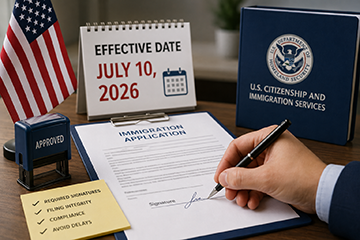
Effective July 10, 2026, U.S. Citizenship and Immigration Services (USCIS) will implement an Interim Final Rule amending its regulations governing signatures on immigration benefit requests. The rule strengthens USCIS's authority to reject or deny immigration benefit requests that do not contain valid signatures and reflects the agency's continued focus on filing integrity and procedural compliance.
While the rule does not change the underlying standards for what constitutes a valid signature, it significantly increases the consequences of submitting a filing that USCIS later determines contains an invalid signature. As a result, employers, petitioners, applicants, and immigration practitioners should exercise increased diligence when reviewing immigration filings before submission.
What Has Changed?
The Interim Final Rule amends 8 C.F.R. § 103.2(a)(7) to provide USCIS with greater discretion when it determines that a benefit request submitted on or after July 10, 2026, does not contain a valid signature.
Under the Interim Final Rule, the regulations now expressly provide that, for benefit requests submitted on or after July 10, 2026, if USCIS accepts a filing and later determines that it was not submitted with a valid signature, USCIS may, in its discretion, reject or deny the request.
Previously, USCIS generally rejected benefit requests that were submitted without a required signature. Under the Interim Final Rule, if USCIS determines after accepting a filing that it does not contain a valid signature, the agency may deny the benefit request rather than allowing the deficiency to be corrected. In addition, when USCIS denies a filing on this basis, the agency may retain the associated filing fee.
USCIS Guidance on Valid Signatures
USCIS considers the following signatures acceptable:
USCIS generally considers the following signatures unacceptable:
Why This Matters
Many immigration benefit requests require signatures from multiple parties, including petitioners, applicants, beneficiaries, preparers, interpreters, and authorized representatives. An omitted or otherwise invalid signature may now result in more significant consequences, including rejection or denial of the filing, potential loss of filing fees, additional delays associated with refiling, and, in some cases, the inability to meet statutory or regulatory filing deadlines.
Accordingly, employers should ensure that internal review procedures include careful verification that all required signatures have been properly executed before petitions or applications are submitted to USCIS.
Key Takeaway
The July 10, 2026 Interim Final Rule underscores USCIS's increased emphasis on compliance with signature requirements. Although the standards governing valid signatures remain largely unchanged, the consequences of submitting a filing with an invalid signature are now significantly greater. Employers, petitioners, applicants, and immigration practitioners should carefully review all immigration filings before submission to help avoid unnecessary delays, rejections, denials, and the potential loss of filing fees.
For questions regarding the new USCIS signature rule or assistance with preparing immigration filings, please contact your trusted Chugh, LLP immigration professional.
Sources:

© 2026 Chugh LLP Affiliate Network. All Rights Reserved


